Grand Départ a great success for host cities
| Grand Départ
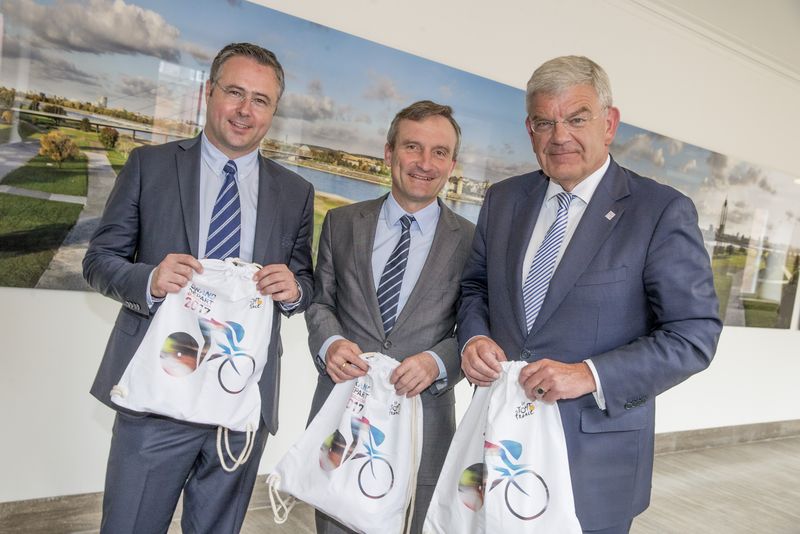
Mayor Geisel (centre), fellow Mayor Jan van Zanen from Utrecht (right) and Cyrille Tricart (A.S.O.)
Public festival mood along the route and sustainable effects, for example, for city marketing and the promotion of bicycle traffic. The goals pursued by the state capital in hosting the Grand Départ Düsseldorf 2017 have long been a reality for other host cities.
Example Utrecht - host of the Grand Départ 2015: around one million visitors, an economic effect of 25.3 million Euros and a media value of around 35 million Euros - that’s the conclusion of Utrecht’s Mayor Jan van Zanen. In addition, 2,000 journalists from more than 700 media reported in and on Utrecht.
Utrecht’s Mayor Jan van Zanen: "From 26 March 2015, 100 days before the Grand Départ, the city of Utrecht was immersed in the festive atmosphere of one of the world’s biggest annual sporting events: the Grand Départ of the Tour de France. The Tour fever reached its peak in the first week of July, with the starting shot for a week of celebrations. Over a million visitors came to Utrecht during the days of the Grand Départ, 2,000 (inter-)national journalists and 1,500 volunteers, so-called Tour Makers, showed the audience the way. It was a successful, happy and 'yellow' event."
The other former Grand Départ hosts also look back with satisfaction on the start of the Tour in their towns in a video at www.youtube.com/stadtduesseldorf.
Jean-Francois Le Grand, Chairman of the La Manche Grand Départ association Grand Départ 2016 - La Manche: "It was a big party that we had. We are proud that the Tour started with us. I think what is important is the renown the start of the Tour brings. The images broadcast all over the world from our region by television contributed to this. The hotels were over 93 percent full - that would not be the case if the Tour de France was not here."
As the evaluation of the region La Manche shows, around 880,000 visitors followed the events from 1 to 3 July 2016. 76 percent of the visitors came from France and 24 percent from abroad. The overnight guests spent 74 Euros per day per head, while the day visitors each invested 32 Euros per day. The Grand Départ 2016 was broadcast in 190 countries, and in Europe alone, around 44 million television viewers watched the start of the Tour. The cumulative transmission time of the three event days totalled 209 hours and 43 minutes.
Sir Gary Verity, Chief Executive of "Welcome to Yorkshire Grand Départ 2014": "If you want to put your city, your town, your region on the map, it’s really simple: just get the start of the Tour de France. We worked very hard on the project. For 18 months, my team did hundreds of road shows, explained in towns and schools what the Tour was and how to get involved. Millions and millions of people, all with smiles and fantastic emotions on their faces at the Grand Départ in Leeds gave us a huge sense of pride. And we saw people getting engaged and bringing communities together like we’ve never seen before. We had a record tourist year in 2014 and another one in 2015 - through the Tour de France. Cycling has exploded in Yorkshire. Last year, (2015) because of the Tour, 15,000 children in Yorkshire rode a bike, who would not have done so otherwise."
H.S.H. Prince Albert II, host of the Grand Départ 2009: "I have fond memories of the Grand Depart, because we had been waiting for it to come to Monaco for a long time, and I found it a pity that we were not part of the big family of towns and cities that have hosted it. I think that the young people here were especially enthusiastic about it. The proof is that we now have a small cycling team."
André Gilles, Member of Parliament and President of the Liège Province, host of the Grand Départ 2004 and 2012: "For us, the Tour de France is a legendary event. You can talk with the riders and get within touching distance of them. It is this type of close contact that encourages people from all generations to come and watch the Tour. It provides a major spotlight for the towns and cities that are lucky enough to welcome the Tour de France, especially the hosts of the Grand Départ - an event which is accessible to everybody, and which is seen throughout the world. The legacy that these two Grand Départs have left is the continuing desire to see the Tour de France come here again. It also has an impact on the lives of the inhabitants: events like these are a source of motivation to start cycling again."
Cyrille Tricart, responsible for the Grand Départ host cities at the Tour organiser A.S.O.: "We receive positive feedback from all the previous Grand Départ towns and regions. Since the Tour de France started in London in 2007, alongside the big international focus and the direct revenues, there is also a lasting legacy that benefits the host."
That’s also something that the state capital aims to achieve through the Grand Départ Düsseldorf 2017: the study carried out in 2015 by the accounting firm Deloitte & Touche GmbH forecast economic effects of 57.1 million Euros for Düsseldorf in the hotel and catering sector, tax revenues of 2.28 million Euros for the city and a media value of 30 million Euros.
Mayor Thomas Geisel: "The fact that our goals are achievable is shown by the experiences of my colleagues from other Grand Départ host cities. The enthusiasm with which Jan van Zanen and the other hosts still talk about the event today shows me that Düsseldorf has made an excellent decision and will probably benefit from hosting the Grand Départ for a long time to come."